
Reviewed · SOVIET BUNKER TOURS
Soviet Riga: Vintage Car Tour & Life Behind the Curtain
Soviet Riga rolls by in a vintage car. This 2.5-hour evening tour uses a restored 1979 VAZ 2103 to connect famous buildings with what life felt like under Soviet rules. You get guided commentary, nostalgic cassette music, and a symbolic ending ritual near Vanšu Bridge.
What I like most is how the tour stays grounded in daily life, not just big monuments. The English-speaking driver-guide focuses on ordinary citizens, from culture and housing to media power, and that is a big part of why it feels real instead of lecture-like. I also love the final touch: 1980s-style cassette music on a restored Radiotehnika tape deck, followed by the vodka toast.
One thing to consider: the experience is specific in theme. If you are expecting a typical Riga highlights loop with shopping stops and postcard viewpoints, this will feel more historical and slightly moodier than that.
In This Review
- Key highlights to look forward to
- Entering Soviet Riga the right way with a 1979 VAZ 2103
- The 6:00 pm plan: small group, guided pace, and mobile ticket
- Dailes Theatre: how culture and censorship shaped expression
- VEF factory grounds: working life under state production
- Purvciems apartments: seeing Soviet housing and family life
- Latvian Academy of Sciences: Stalinist architecture as ideology
- Riga Radio and TV Tower: media dominance and state control
- Vanšu Bridge ending: cassette music and a symbolic vodka toast
- Price and value: where $113.74 fits in Riga
- Who this Soviet Riga tour suits best
- Should you book this Soviet Riga vintage car tour?
- FAQ
- What is the duration of the Soviet Riga tour?
- How much does the tour cost?
- What time does the tour start?
- Where do I meet for the tour?
- Does the tour end at the same place it starts?
- What kind of vehicle is used?
- Is there an English-speaking guide?
- What is included at the end of the tour?
- Is bottled water included?
- How many people are on the tour?
Key highlights to look forward to
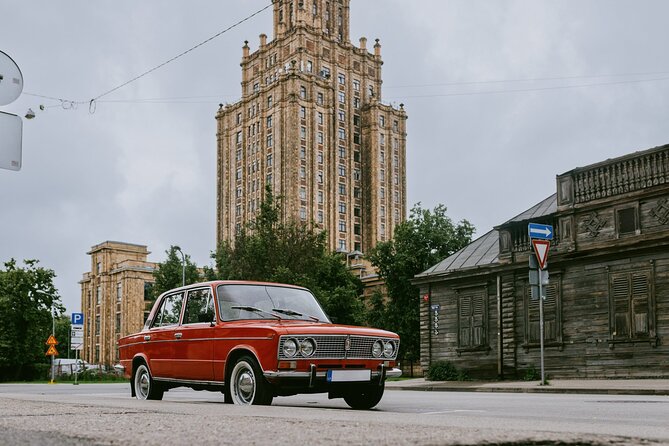
- Restored 1979 VAZ 2103 transport that turns city streets into part of the story
- Small group size (max 3), which helps the guide keep the tone personal
- Six Cold War related stops, each tied to how control shaped everyday life
- Cassette-era music and a symbolic vodka toast at the end near Vanšu Bridge
- Free entry at each stop listed in the route, so you are not hunting tickets
More Soviet-era places you can get inside:

Entering Soviet Riga the right way with a 1979 VAZ 2103
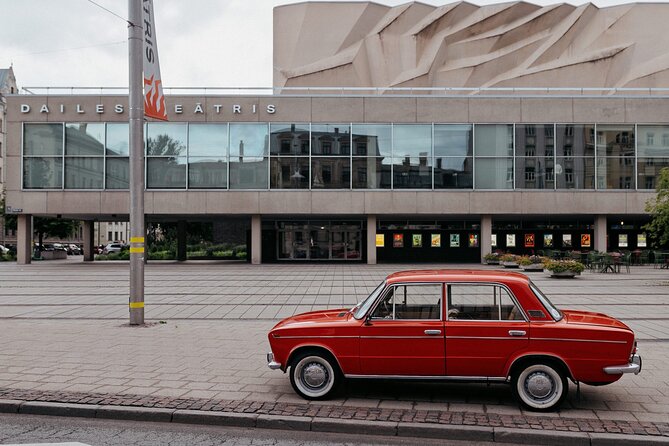
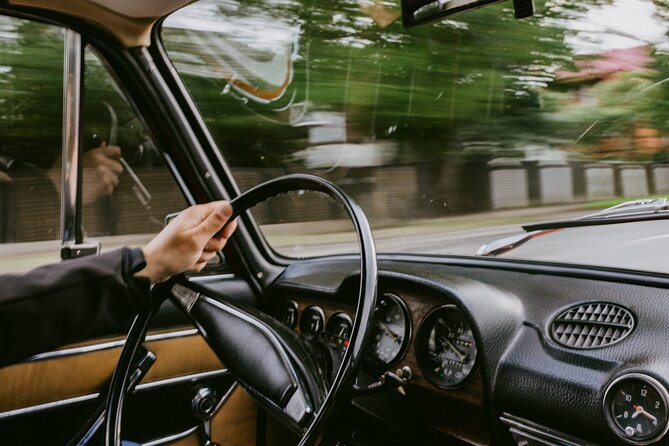
If you want to understand a place, you do not only need buildings. You need the feeling of moving through the era. This tour does that with a restored 1979 VAZ 2103, a car that immediately signals the Soviet world you are going to talk about. The ride changes your pacing. It also changes what you notice, because you are not speeding through. You are watching from a slower, more old-school angle.
I like that it is not just a drive-by route. The guide ties what you see to how the system worked, whether that was in culture, factories, housing, or broadcasting. That is where the “life behind the curtain” idea becomes practical. You can stand in a place and learn the official face, then connect it to the human side: how people expressed themselves, worked, lived, and heard the news.
You should also note the tone the tour uses. Even when the topics are heavy, the structure stays approachable: short stop times, guided storytelling, and a clear ending moment. It feels like a compact evening lesson, but delivered with a bit of nostalgia rather than a museum vibe.
The 6:00 pm plan: small group, guided pace, and mobile ticket
This tour starts at 6:00 pm and runs about 2 hours 30 minutes. You meet at Herdera laukums 6, Centra rajons, Rīga, LV-1050, Latvia, and the tour ends back at the meeting point. That return-to-base detail matters. It means you do not need a separate plan for getting home after the ride. You can just wrap up near where you started.
The group limit is max 3 travelers. That usually makes a difference in two ways. First, you get more back-and-forth if you have questions. Second, the guide can keep the pace tight. With a small group, the stops can stay focused instead of turning into long waits.
You also get a mobile ticket, and bottled water is included. That sounds minor, but it helps on a longer evening outing when you want to stay comfortable and not spend time figuring out water or ticket checks.
One more practical note: the meeting point is near public transportation. So even if you are not taking a taxi, you should be able to reach the start with normal Riga transit.
Dailes Theatre: how culture and censorship shaped expression
Your first stop is Dailes Theatre, where the guide explains how Soviet ideology influenced performing arts and public expression. This is a good opening choice because theater is one of those places where you can see ideology at work without needing heavy technical explanations. You can look at the setting, then listen to how censorship affected what could be said and how culture operated in public.
The tour’s value here is the cause-and-effect framing. You are not just learning that censorship existed. You are hearing how it functioned and why culture mattered to the state. That makes the whole evening easier to follow. Once you understand that culture could be managed, the next stops about industry and media start to connect.
Time here is about 10 minutes, and that is honestly a smart length. It gives you the key ideas without turning it into a long lecture before the car ride even settles you in.
A drawback for some people: if you already know a lot about Soviet arts policy, the start might feel like a fast primer. But if you are newer to the subject, this stop is a strong orientation.
VEF factory grounds: working life under state production
Next you visit the grounds of VEF, the legendary Soviet-era factory tied to industrial production. Here the tour shifts from culture to labor. You hear stories about working-class life, innovation under state control, and what it meant to build and produce inside a system where production goals were set from above.
This stop works because factories are easy to picture. Even if you do not walk deep onto industrial property, the idea is clear: you are learning how people spent time, energy, and skill in an environment shaped by the state. The guide connects that to daily life, not just economics.
Expect about 15 minutes here. That gives enough time to absorb the main points and still keep the route moving. You also get free admission at the stop, so you are not adding extra costs or ticket friction to the evening.
If you like social history, this is one of the most satisfying segments. If you only want architecture and big landmarks, you might find this stop slower in terms of visual wow factor. But the tradeoff is that you leave with a clearer understanding of how the Soviet system affected real routines.
Different day, same base in Riga:
- Riga Old Town walking tour★ 4.5 · 304 reviews
- Latvian food tasting tour at Riga Central market★ 4.5 · 241 reviews
- 2 countries! Hill of Crosses, Rundale Palace and Bauska castle★ 5.0 · 225 reviews
- Discover Riga Bike Tour★ 5.0 · 166 reviews
- From Riga: Husky Sledding or Wheel Kart Tour★ 4.9 · 155 reviews
Purvciems apartments: seeing Soviet housing and family life
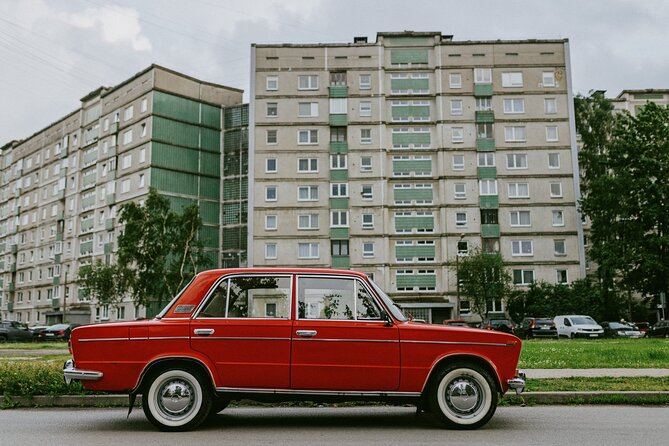
Then you head to Purvciems, where you see classic Soviet block-style apartment buildings. This is where the tour gets very “everyday.” The guide shares insights into housing, family structure, and how ordinary citizens experienced daily life under the Soviet regime.
I like this stop because it is not abstract. Apartments are where ideology becomes personal. Housing affects privacy, space, and routine. When the guide connects the building style to family life and living conditions, it turns a neighborhood scene into something you can actually relate to.
You spend around 15 minutes here. That length is helpful because you can notice the shape and layout from the outside, then let the guide’s explanation do the heavy lifting. You are not stuck in one place for ages, and you still get meaning.
One consideration: apartment blocks can look repetitive if you are only sightseeing. The tour avoids that by keeping the storytelling tied to how people lived, not just what the facades look like. If you approach it with that mindset, the stop becomes much more than a photo moment.
Latvian Academy of Sciences: Stalinist architecture as ideology
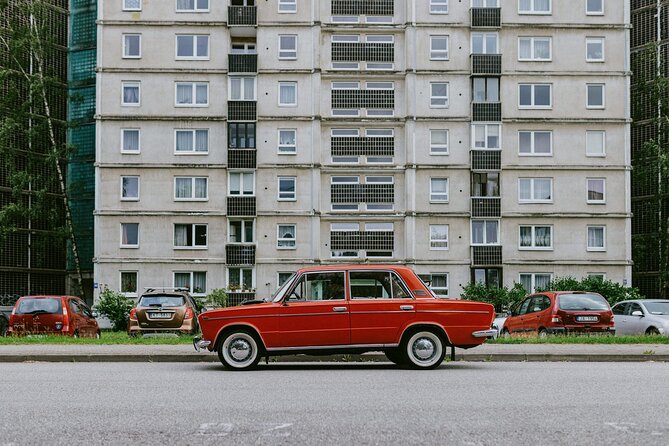
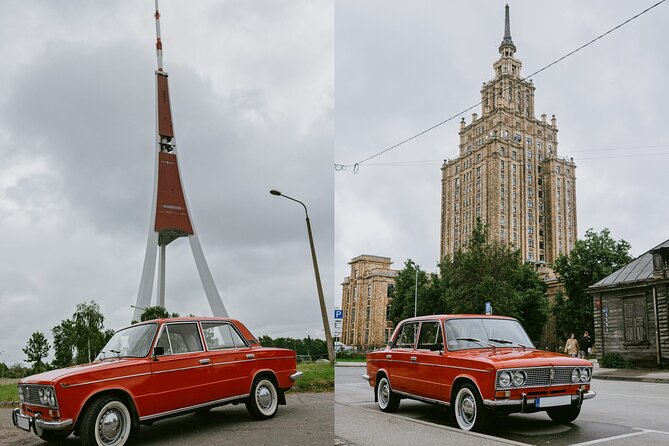
The tour moves to the Building of the Latvian Academy of Sciences, a famous Stalinist skyscraper with strong symbolic weight. The guide helps you admire the architecture while also learning how Soviet architecture was tied to ideological control.
This is a thoughtful balance: you get to appreciate the physical presence of the building, then you get the interpretation behind why that style mattered. In other words, you do not just admire shapes. You learn what those shapes were meant to communicate.
Time here is about 10 minutes. That is perfect for this kind of stop. The building’s scale does the visual work, and the guide’s explanation gives it political context without dragging on.
If you are sensitive to heavy political themes, keep your expectations realistic. This is not a neutral architecture walk. The symbolism is part of the point. Still, the short stop length helps you absorb without feeling trapped in the topic.
Riga Radio and TV Tower: media dominance and state control
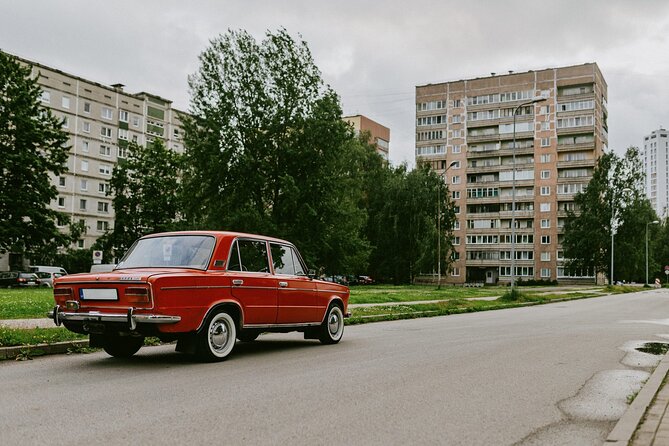
One of the most pointed stops is Riga Radio and TV Tower. This is a Cold War-era symbol of Soviet media dominance, and the guide talks about propaganda broadcasting and how state information control shaped what people heard and saw.
This segment is valuable because it connects the dots across the evening. If culture was shaped, factories were controlled, and housing reflected the system, then media becomes the loudest channel. You start to see the overall logic: control is not just physical. It also lives in messages.
You spend around 10 minutes here, which again works well for the theme. The tower is already a visual anchor. The guide provides the key ideas so you do not have to research on the spot.
A practical thought for you here: if you like understanding how governments communicate, this stop will feel especially relevant. Even if you know the basics of Cold War propaganda, hearing how the guide frames state information control in this specific location makes it more concrete.
Vanšu Bridge ending: cassette music and a symbolic vodka toast
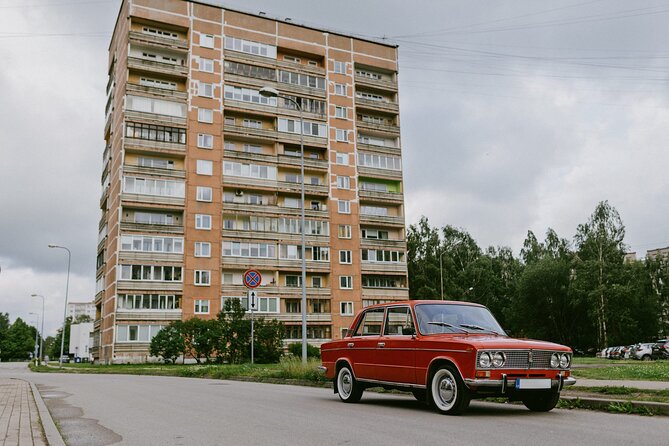
The final stop is near Vanšu Bridge, where the tour ends with a symbolic Soviet-style vodka toast while listening to 1980s cassette music on a restored vintage Radiotehnika tape deck. This part is not just for fun. It is a deliberate emotional shift.
The goal is to close the story on something sensory. The cassette sound, the tape deck, and the small ritual bring a “you are there” feeling that plain commentary alone cannot create. It is nostalgic, but it also functions like a cultural marker of an era. You are not only learning about the system. You are ending with its vibe.
Time here is about 15 minutes. That gives you time to enjoy the music and the moment without rushing.
One note: vodka toast is symbolic as described, and the tour includes bottled water. If you do not want to drink alcohol, you can still treat it as a ritual moment and focus on the music and storytelling around it.
Price and value: where $113.74 fits in Riga
At $113.74 per person, this is not a bargain-basement city walk. You are paying for the vintage car, the small group experience, and the guided storytelling that ties multiple Cold War related locations together.
So where does the value come from?
- You get a restored car experience rather than just being driven in a modern vehicle.
- The group is very small (max 3), which typically makes the guide’s attention feel more personal.
- You get a set route of six stops, each with guided commentary and free admission at the listed locations.
- You get extras that do not cost you time or money, like bottled water and the cassette music plus vodka toast ending.
Is it worth it if you only care about photos? Maybe not. But if you want context and you like history that connects to everyday life, the pricing starts to make sense. You are essentially buying a themed evening with transport, interpretation, and atmosphere, not just access to sights.
My practical advice: if you are visiting in the evening anyway and you like guided experiences, this can be a smart use of time. It is also scheduled at 6:00 pm, so it works well with normal daytime sightseeing.
Who this Soviet Riga tour suits best
This tour fits you if you like stories that explain how systems affect people. It is also great if you enjoy social history, not just architecture.
It is especially good for:
- People who like small group tours where you can actually ask questions
- Anyone who wants to see Riga through a Cold War lens, not a generic highlights route
- Travelers who appreciate themed details like vintage tech and music
It might be less ideal if you:
- Want a standard Riga sightseeing flow focused on modern food stops and quick photo ops
- Do not want political and ideological topics at all
- Prefer longer stops where you can explore on your own for a full hour
The one review that exists praises the guide for making you understand the deep and real life of ordinary citizens in Soviet Latvia. That tells me the tour’s strongest ingredient is not the car or the music alone. It is the way the guide connects the places to human experience.
Should you book this Soviet Riga vintage car tour?
Book it if you want an evening in Riga that feels like a story you can walk through. The restored 1979 VAZ 2103, the Cold War site selection, and the sensory ending with cassette music and a symbolic vodka toast make it more memorable than a basic driving tour.
Skip it if you are purely after postcard views and fast pacing with minimal history. This is a guided, thematic experience with short stops and a clear narrative. If that is your style, you will likely find it satisfying.
FAQ
What is the duration of the Soviet Riga tour?
The tour lasts about 2 hours 30 minutes.
How much does the tour cost?
It costs $113.74 per person.
What time does the tour start?
The start time is 6:00 pm.
Where do I meet for the tour?
Meet at Herdera laukums 6, Centra rajons, Rīga, LV-1050, Latvia.
Does the tour end at the same place it starts?
Yes, the tour ends back at the meeting point.
What kind of vehicle is used?
You ride in a fully restored 1979 VAZ 2103.
Is there an English-speaking guide?
Yes, it includes an English-speaking driver-guide with guided commentary.
What is included at the end of the tour?
The tour includes a symbolic Soviet-style vodka toast, plus cassette music played on a restored vintage Radiotehnika tape deck.
Is bottled water included?
Yes, bottled water is included.
How many people are on the tour?
This activity has a maximum of 3 travelers.
Newest entries out of Riga
- Riga Beer Bike
- Sunrise or sunset SUP/kayak Adventure in the bog from Riga
- Create your own Gin at Riga Gin Laboratory
- Small Group – Hill of Crosses, Jelgava and Jurmala / 2 Countries
- Discover Riga’s most Photogenic Spots with a Local
- Riga City Tour and Panoramic Ride on the Riga Eye
- Private Chocolate Masterclass in Old Town of Riga
- Day trip to Tallinn from Riga
Soviet Bunker Tours, compared.
Private Day Tour to Sigulda, Turaida Castle and Soviet Bunker
Read our review →
Full-Day Private Trip to Nuclear Missile Base and Secret Soviet Bunker
Read our review →Soviet Bunker, Seaside Fortress + Authentic BBQ lunch with beer
Read our review →
More Riga days like this