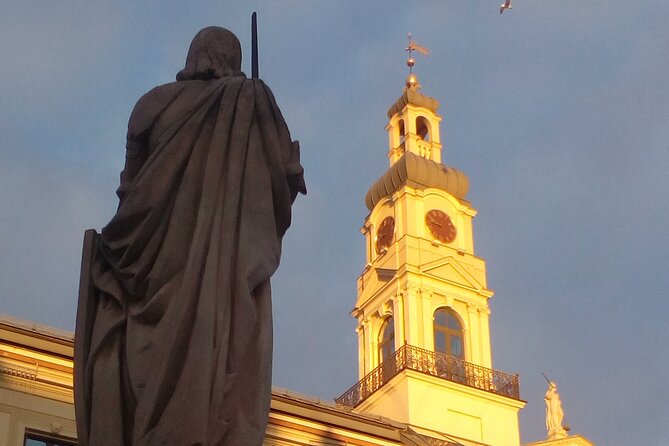
Reviewed · WALKING TOURS
2 Hours Walking Tour in Legends and Secret of Riga’s Old Town
Riga has secrets in plain sight. This 2.5-hour walk through Old Town is built around stories you can actually point at, from golden roosters to medieval symbols you will miss if you just wander. I also like the hands-on stop for Riga Black Balsam and the way the route helps you get your bearings fast.
One thing to plan for: many key moments are viewed from outside or in free areas, so this is not a nonstop ticket-punching day. If you want deep, full church interiors every step of the way, you may find the pacing more “see and learn” than “go inside everything.”
In This Review
- Key highlights you will actually feel on the walk
- Value and pacing: a private 2.5-hour walk for up to 6
- Starting point: where the walk begins and how pickup works
- A guide like Lina: stories with visuals and room for questions
- Old Town map reading: from medieval roosters to the city’s trade spine
- St. Peter’s Church: the golden roosters and why 666 shows up here
- Ratslaukums Town Hall Square: market origins, Key to Riga, and the first decorated tree story
- House of the Black Heads and Roland: when “symbol” becomes a map
- Dome Square and Riga Cathedral: count roosters and listen for the organ story
- Trade power walk: Stock Exchange’s Venetian gondola and the Three Brothers complex
- Narrow streets and Swedish-era leftovers: wine cellars, soldier barracks, and a ghost legend
- Black Magic Bar, Kunze the alchemist, and the tastiest part of the walk
- Freedom Monument, Laima Clock, and everyday Riga landmarks with meaning
- Guilds and 19th-century architecture: Small Guild, Great Guild, and a merchant mindset
- Russian empire era building and St. John’s Church: faith, punishment, and surviving architecture
- Vecriga walls to Kalēju iela blacksmith street, then a Soviet-era skyline moment
- Should you book this Riga Old Town walk?
- FAQ
- How long is the walking tour?
- How much does it cost, and how many people are in a group?
- Is this tour private?
- What language is the tour in?
- Is pickup available?
- What’s included in the tour price?
- What is the meeting point and where does the tour end?
- Can I cancel for a full refund?
Key highlights you will actually feel on the walk
- Riga Black Balsam tasting as part of the experience, not an optional add-on
- Golden roosters, 666, and Christian symbolism at St. Peter’s Church
- Underground access at the House of the Black Heads (yes, under the city feeling)
- Hanseatic-era symbols through Roland and the Guild buildings
- Christmas tree origins and Riga’s “firsts,” including a marker for 1510
- 20th-century memory stops like the Freedom Monument and the Baltic Way footprint
More on foot around Riga:
Value and pacing: a private 2.5-hour walk for up to 6
This costs $108.43 per group for up to 6 people, for about 2 hours 30 minutes. The private setup matters, because your guide can slow down where your questions land, instead of rushing everyone to the next corner. For a group of four to six, the per-person cost can feel pretty reasonable. For one or two people, it is pricier, so treat it like a “best intro to Riga in one afternoon” purchase.
The other value lever here is density without chaos. The stops are short, so you keep moving, but you also get enough context to connect buildings to people, trade, and power. It is the kind of tour where you finish and can still remember why one statue matters and why one street is narrow.
Starting point: where the walk begins and how pickup works
You start at the Grand Palace Hotel, Pils Street 12. The tour ends back at the same meeting point, which makes planning dinner and museums easier because you are not dropped across town.
Pickup is offered. The details list pickup at St. Peter Church in Riga, Reformacijas laukums. If you are coordinating with another person or you are coming from a tram stop, this can save time, especially on a day when Riga’s cobblestones do not need extra stretching.
And yes, you will want to wear comfortable shoes. This is a real walking loop, and a lot of the “wow” moments happen at corners and in squares where you stand for a few minutes to look and listen.
A guide like Lina: stories with visuals and room for questions
Many groups are guided by Lina, and that name shows up for a reason. Her style is practical and lively, and she uses visual support, including a folder of pictures that helps you understand what places looked like at different moments in time. That matters because Old Riga’s layers can feel confusing unless someone translates the timeline into what you are seeing right now.
The other thing people love is that the tour does not feel rushed. Even with 20-plus stops, the guide’s pace stays human, and the questions you ask do not get bulldozed by a strict script. Family groups have also been mentioned as a good match, which usually means the explanations stay clear and not overly academic.
Old Town map reading: from medieval roosters to the city’s trade spine
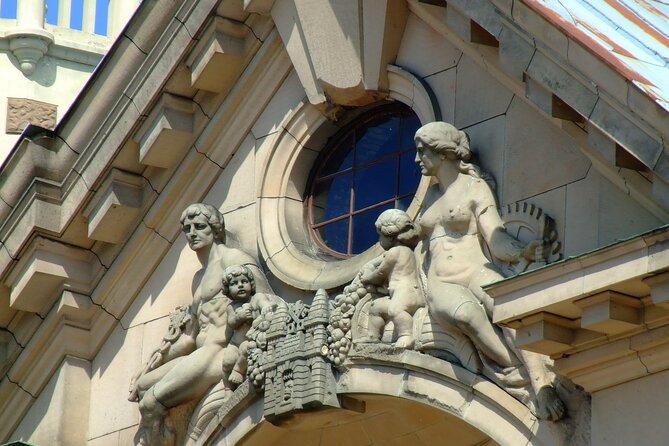
Right away, the tour trains your eyes. Riga’s Old Town is full of symbols that look decorative until someone explains the logic. You will repeatedly learn how people used architecture like a public message board, from religious imagery to merchant identity.
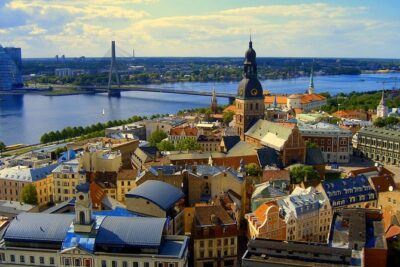
After the first church stop, you move toward the ceremonial heart around Ratslaukums (Town Hall Square) and then into the tight street web where power lived: guilds, markets, and the entrances that controlled who moved in and out of the city.
If you like walking tours that help you read a city like a book, this route is built for that. When you finish, you should be able to look at a square and say, “This is where commerce met authority,” even if you never memorized dates.
Two hours and you are back:
- Small Group Art Nouveau walking tour 2h★ 4.5 · 6 reviews
- Best Intro to Riga in 2 hours with a Local★ 5.0 · 1 review
St. Peter’s Church: the golden roosters and why 666 shows up here
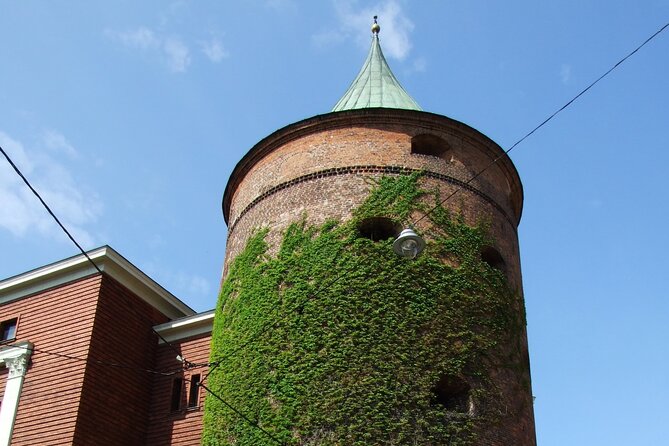
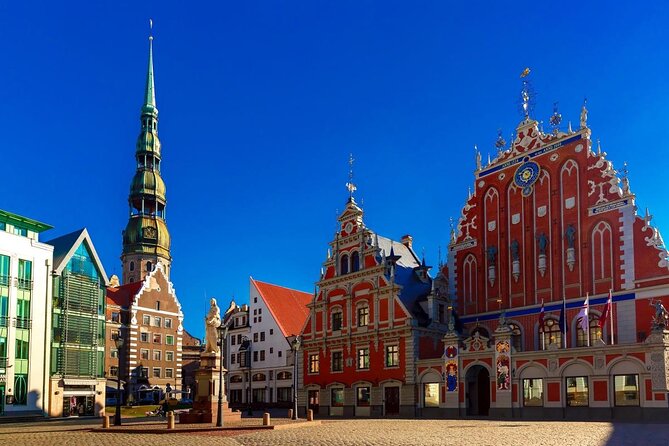
You start with St. Peter’s Church, and you mostly observe it from outside as the oldest Lutheran church in Riga. The guide connects medieval tradition to those famous golden roosters, including the Christian point of view, not just the fun folk legend angle.
Then comes the sharper story: the church’s fate being affected by 666. It sounds like something out of a medieval rumor mill, but it is presented as a way people interpreted events and meaning. If you like symbolic thinking and city lore, this is an early win because it sets the tone for the rest of the walk.
The stop includes an admission ticket for the part you can access. Expect to spend a short window there, enough time to look up, listen, and orient yourself.
Ratslaukums Town Hall Square: market origins, Key to Riga, and the first decorated tree story
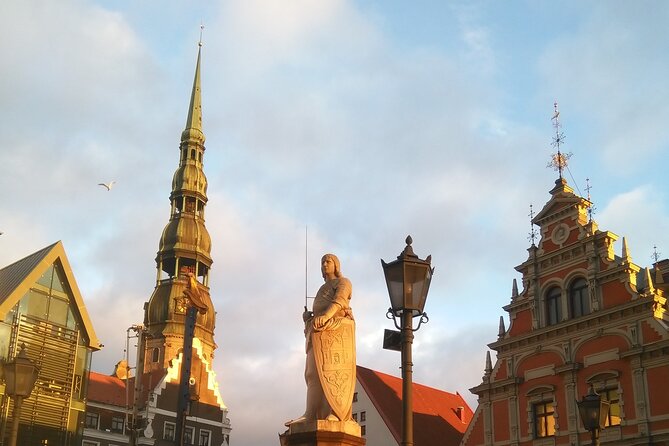
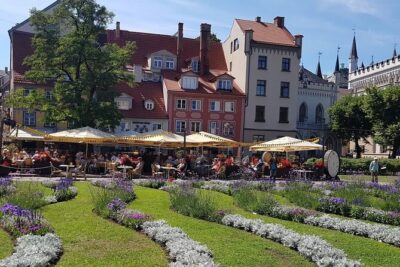
From St. Peter’s, you head into Riga Town Hall Square, the oldest cultural-representative center. The big idea here is that this square was not always an official civic plaza. It started as a city market, where merchants from around the region brought goods to trade.
This is also where you start getting landmark spotting. You will look across toward the left bank of the Daugava River, including the Latvian National Library and the Museum of the Occupation of Latvia area. Even if you do not go into those museums today, knowing what you are seeing makes the view feel intentional.
The tour also covers the Key to Riga story and ties in Christmas traditions that are supposed to trace back to the 16th century. You will even see a memory place dedicated to the tradition of the first decorated Christmas tree, with Riga’s reputation for early celebrations in the mix.
If you travel around the Baltic and care about how traditions traveled and changed, this stop gives you a framework to interpret what you see later at other squares.
House of the Black Heads and Roland: when “symbol” becomes a map
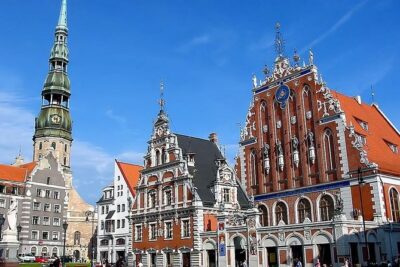
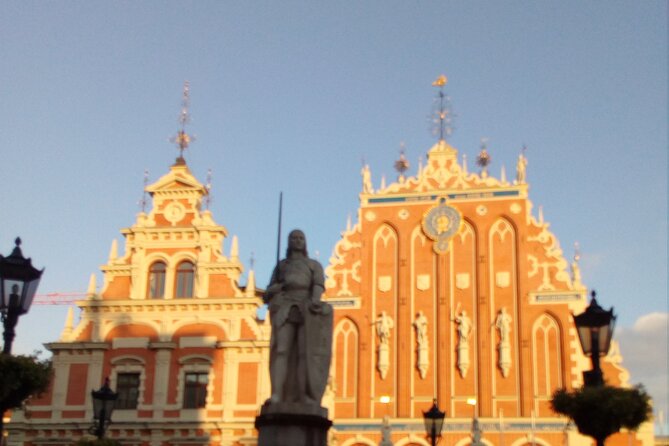
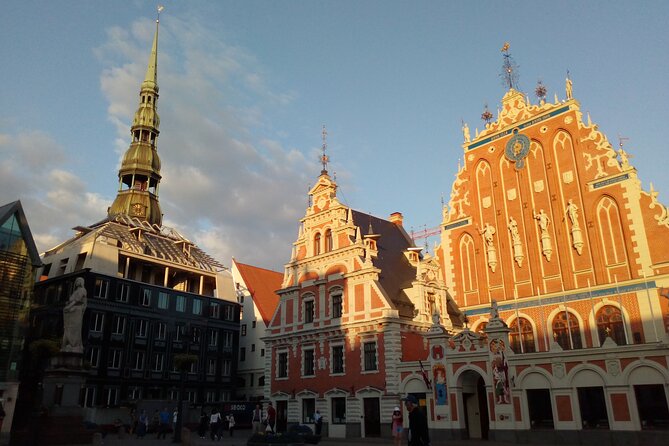
Next is the House of the Black Heads, one of Riga’s most beautiful historic buildings. You hear about its decoration and the clock on the facade, then move into the story of the brotherhood of the Black Heads.
This is also the stop that goes beneath the surface. You visit the free part of the house and you will see the underground. If you like your history with atmosphere, that underground moment tends to stick with people because it makes the building feel like more than a postcard.
The guide then points out the alchemy and hermetical symbolism tied to the facade. You do not need to be an occult scholar to enjoy it, but you will start noticing how “mystery” was part of how merchants and brotherhoods displayed power.
Then you shift to the Statue of Roland. This statue is not random. It represents freedom for the medieval city and connects Riga to the Hanseatic Union, where Riga belonged since 1283. The guide also tells the story behind Roland’s shield and sword, so you are not just staring at a figure, you are understanding why the city chose that imagery.
Dome Square and Riga Cathedral: count roosters and listen for the organ story
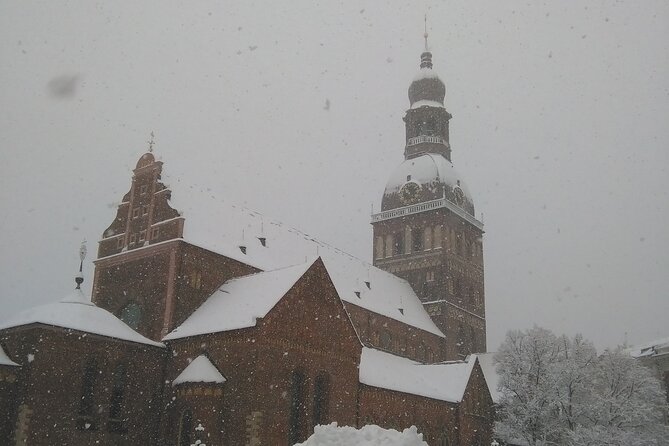
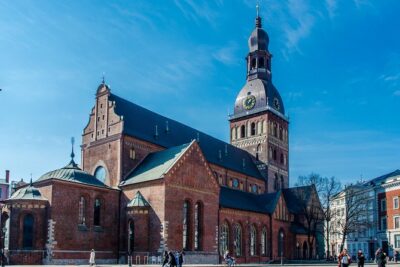
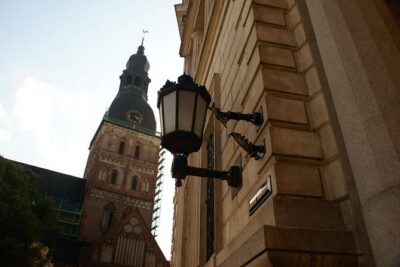
At Dome Square, you view the main Lutheran church from outside, the Riga Cathedral, and you count the golden roosters in the biggest Old Town square. You also get the “secret geometry” idea of the space, plus a practical note: this is where the main Christmas market happens each year.
Then you move to Riga Cathedral, where you learn about the church’s foundation and construction and visit the free part of the Dome. The guide also points out the last work of Rafael Santi, plus the pipe organ story. The organ is described as having been the biggest in the world in the 19th century, and now one of the best sounding instruments in the world.
Another neat detail: merchants planned their day by looking at the Dome’s rooster. That kind of human timing story is what makes a tour feel grounded. You are not only learning dates, you are learning how people actually used the city.
Admission ticket includes the access you need for the included parts, so check your expectations if you hoped for a fully guided interior of every wing. This is still a “smart access” stop, not a museum-day.
Trade power walk: Stock Exchange’s Venetian gondola and the Three Brothers complex
The Riga Stock Exchange Building is next, and the guide gives you architecture context as you pass through. One standout is the Venetian gondola display, described as the only one in Riga. It is part of the Venetian Neo-Renaissance look, built in the 19th century, and the building now hosts a museum of foreign arts.
From there, you go to Three Brothers, the Latvian Museum of Architecture. Here the key is development. The three houses show different periods of dwelling house construction, and you visit the oldest dwelling house, the Oldest brother, from the 15th century, plus museum material around Latvian architecture.
In the inner yard behind the complex, you can see the oldest coat-arm of Riga. The guide also includes the story of medieval taxes, including the window tax. That detail is great because it connects “old architecture” to how ordinary people were affected by policy.
You will get an admission ticket included for the relevant access, but this stop also fits travelers who prefer a blend of exterior photo ops and a short, meaningful inside time.
Narrow streets and Swedish-era leftovers: wine cellars, soldier barracks, and a ghost legend
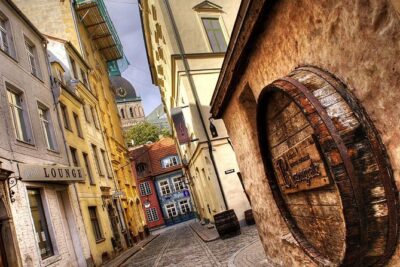
The walk takes you through some of Riga’s tight lanes, and this is where you start to feel the city’s quirks physically.
You will see Rozena iela, described as Riga’s most narrow street, and you learn about the old City Hall wine cellar from the 13th century. Even though you see it from outside, the story explains why narrow streets got their reputation, including the idea of streets of the drunk knight.
Then comes Bremen Town Musicians, the recognizable monument given to Riga by the sister city of Bremen. The description links it to Bishop Albert’s Bremen origin and notes the sculptor Krista Baumgertel, with the monument installed in 1990.
After that, you head toward the Swedish-era structures. You visit the Swedish Gate, the only outer gate made in Swedish time, and hear the legend about a Riga ghost. You also see the house of the city executioner.
Nearby is Jacob’s Inn, described as the longest building in Old Town, built as barracks for 5,000 Swedish soldiers. Today it has souvenir shops, cafeterias, restaurants, and offices, which makes it easy to break into the “tour mode to snack mode” switch if you want.
If you like history that feels like a living city and not a dead theme park, these stops are exactly that. A street can look decorative, but once you understand its military or trade purpose, it changes how you walk through it.
Black Magic Bar, Kunze the alchemist, and the tastiest part of the walk
One of the most fun stops is Black Magic Bar. The legend claims this was once a pharmacy where Riga Black Balsam was invented in the 18th century.
You will learn about the hidden symbolism of alchemy connected to the story, and the guide points out a secret door leading to the laboratory of alchemist Kunze, inventor of the black balsam. Then the tour delivers the practical part: you can sample Riga balsams and drinks based on the famous liqueur.
This stop connects the idea of “symbols everywhere” to something you can taste. It also gives you a break from constant walking without turning the tour into a long stop at a bar. Since the tour includes an alcoholic beverage tasting as part of the experience, you can keep the budget clearer.
Freedom Monument, Laima Clock, and everyday Riga landmarks with meaning
After the Old Riga center, the tour expands your view of Latvia’s identity.
You visit Freedom Monument, built during the first Latvian Republic. The guide covers hidden symbolism, plus construction history and why it is so important to Latvian people. This stop hits differently than the medieval sites because it is not only about art. It is about memory made physical.
Then you stop at Laima Clock, Riga’s main meeting point. “Laima” is described as the biggest chocolate producer in Latvia, and the guide explains why the clock got its name. It’s a simple stop, but it is the kind of practical landmark that helps you navigate later without your phone.
You also pass the shortest street in Riga, Ķēniņu iela, just for about a minute, along with a quick explanation of how it got so short. You then see the Cat House, including the legend behind it and how the black cat became one of Riga’s symbols.
At Livu Square, you learn the square’s history and hidden symbolism, with the Liv’s head monument as your visual anchor. These are short stops, but they matter because the guide ties them together into a city personality. Riga feels a little theatrical, and that is part of the charm.
Guilds and 19th-century architecture: Small Guild, Great Guild, and a merchant mindset
Two key stops focus on Riga’s craft and merchant organization.
At the Small Guild of Riga, you learn about the craftsmen union and its foundation story. The building was erected in 1864 to 1866 in Neo-Gothic style, tied to architect Johann Felsko.
Then comes the Great Guild, the merchants’ union also known as the Large Guild or St. Mary’s Guild. The description includes that it existed from 1354 to 1936, and that Riga joined the Hanseatic League in 1283 with German guilds becoming more prominent in city life.
If medieval trade history usually feels dry to you, the tour’s angle helps. Guilds are not abstract. You see where money and identity got displayed, and you understand how that shaped what stands on the street today.
You will also see Baltic Way Footprint Monument, a memorial for the 1989 human chain from Tallinn to Vilnius via Riga. It describes roughly 2 million participants forming a 600 km chain, and it notes the commemorating mass demonstration took place on August 23, 1989. The footprint is a small red granite marker at the crossroads of Kaļķu and Vaļņu, near McDonald’s.
This is the contrast stop: the city moves from medieval symbols to modern civic statements, without you needing to switch tours.
Russian empire era building and St. John’s Church: faith, punishment, and surviving architecture
You pass a building described as one of the oldest Russian theatres outside Russia, built during the Russian empire in the second part of the 19th century, with Florentine Neo-Renaissance style. There’s enough description to understand what you’re looking at, even if you do not go inside.
Then you reach St. Jacob’s Catholic Cathedral from outside, with the bell story of the “poor sinners.” The guide explains the bell rang when criminals were brought from prison to Town Hall Square to be executed. That is a heavy detail, but it is exactly the sort of “what happened here” context that makes Old Town feel real instead of cute.
Finally, you see St. John’s Church and hear the story of two Dominican monks walled up alive into the wall. The guide points to where they were found in the 19th century during reconstruction. You also see the oldest Riga gate leading to the Dominican monastery.
These stops are brief, but the stories land because they connect architecture to real lives, punishment, and faith.
Vecriga walls to Kalēju iela blacksmith street, then a Soviet-era skyline moment
The walk ends with a shift from tight medieval lanes to broader structure and even a modern skyline highlight.
You see Vecriga, a section of Old Fortification wall from the 13th century, built by Germans during Livonian order’s time to protect Riga from invaders. You then move to Kalēju iela, Riga’s longest street in Old Town. The guide explains it used to be an embankment of the Riga River, and today it reflects that past with blacksmith association, essentially showing where blacksmiths worked.
Then you get a big contrast: Riga Radio and TV Tower, described as the tallest tower in the European Union. It was built between 1979 and 1989, funded by the central government of the Soviet Union, and its highest point reaches 368.5 meters. Even if you do not go up, it gives you perspective on how Riga built vertical identity in the 20th century.
Before you wrap, you also see the First Christmas Tree Marker, tied to a memory plaque for the first decorated Christmas tree in 1510, and the tour connects this to Riga as a town of four capitals.
Should you book this Riga Old Town walk?
If it’s your first trip to Riga and you want the fastest way to understand Old Town symbolism, buildings, and legends in one smooth loop, I think this is a smart pick. The private group format helps, and the pacing stays friendly even with a long list of stops.
Book it if you care about:
- stories tied to visible details like roosters, guilds, clocks, and gates
- a tasting moment for Riga Black Balsam
- a guide style that uses visuals and keeps the conversation moving
Skip it only if you want a tour that treats every church like a full guided visit with long interior time. This one often emphasizes outside views and free access areas, so plan extra museum or church time separately if that is your top priority. If you bring curiosity and comfy shoes, you should leave Riga’s Old Town feeling like you can read it.
FAQ
How long is the walking tour?
It lasts about 2 hours 30 minutes.
How much does it cost, and how many people are in a group?
It is priced at $108.43 per group for up to 6 people.
Is this tour private?
Yes. It is a private tour/activity with only your group participating.
What language is the tour in?
The tour is offered in English.
Is pickup available?
Pickup is offered. Pickup details list St. Peter Church in Riga, Reformacijas laukums, while the meeting point is Grand Palace Hotel.
What’s included in the tour price?
Included items listed are a Riga Black Balsam tasting (alcoholic beverage degustation) in a souvenir shop, plus included admission tickets for certain stops.
What is the meeting point and where does the tour end?
The tour starts at Grand Palace Hotel on Pils Street 12 and ends back at the meeting point.
Can I cancel for a full refund?
Yes, you can cancel up to 24 hours in advance for a full refund. Canceling less than 24 hours before the start time is not refunded.
Newest entries out of Riga
- Riga Beer Bike
- Sunrise or sunset SUP/kayak Adventure in the bog from Riga
- Discover Riga’s most Photogenic Spots with a Local
- Create your own Gin at Riga Gin Laboratory
- Small Group – Hill of Crosses, Jelgava and Jurmala / 2 Countries
- Day trip to Tallinn from Riga
- Riga City Tour and Panoramic Ride on the Riga Eye
- Private Chocolate Masterclass in Old Town of Riga